


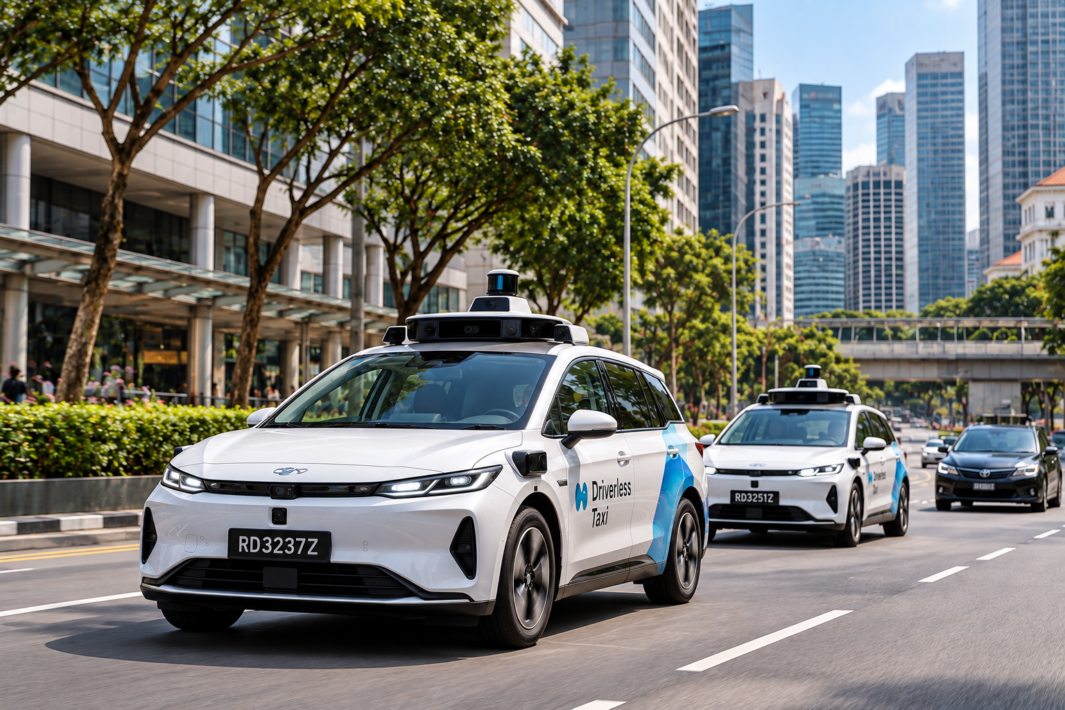

Robotaxis could improve ride availability before delivering lower fares – but adoption and jobs remain challenges.
Autonomous vehicles (AVs) have arrived in Singapore. But public expectations of their roll-out may be getting ahead of reality: The technology could disrupt jobs and transform transport, yet take years to become commonplace. And, even when driverless cars become widespread, consumers may not see the dramatic fare reductions they expect.
Alongside trials by Grab and ComfortDelGro, the recent news of Waymo’s entry into Singapore is another sign that AVs will form a growing share of the country’s point-to-point (P2P) transport system. The company aims to begin bookings for self-driving trips in Singapore come 2028.
Yet, removing drivers from the equation does not necessarily mean cheaper rides or fewer jobs overnight.
The benefits to consumers will depend on how operators deploy the technology, how much competition emerges and whether commuters are willing to use it. Meanwhile, the pace of adoption will shape how quickly drivers are affected.
Don’t expect lower fares in the short term
The paradox is that removing the driver does not automatically make a ride cheaper. The median price of an autonomous Waymo trip in San Francisco in January was US$17.25 (S$22.10), more than 30% higher than the median human-driven Lyft ride, at US$12.99, according to trip data from Obi, a real-time ride-share pricing aggregator.
Despite the higher price, demand for Waymo rides remains strong. Consumers continue to use the service enthusiastically, with some viewing autonomous ride-hailing as a premium product because of the novelty of the technology and the perceived quality of the experience, according to Obi chief executive Ashwini Anburajan.
In other words, eliminating a major labour cost does not necessarily translate into lower fares. Operators may be able to charge a premium for a service that consumers perceive as offering something different.
Over the longer run, however, greater competition among P2P operators should, in theory, put downward pressure on prices. Tesla, a later entrant in San Francisco, pursued a strikingly different pricing strategy: During the same study period, its rides had a median fare of just US$7.39, although the service still operated with a human safety driver. Such aggressive pricing may reflect an effort to attract riders and gain market share.
For Singapore commuters, the more immediate benefits of AVs may be shorter waits and more reliable access to rides when demand is high or human drivers are scarce. A recent personal experience illustrates the problem. On the first day of Chinese New Year, my family could not secure a ride to my parents’ home and had to take public transport instead.
AVs could help address such shortages because they are well suited to the matching function that ride-hailing platforms already perform.
In research on Singapore’s taxi industry and demand shocks, which I co-authored with my postdoctoral fellow Xu Wenxuan, we found that app- and phone-based bookings accounted for much of the additional taxi demand around train disruptions. Street-hail trips also increased near affected stations, but bookings drew drivers from a wider area.
The difference was greatest during the evening rush hour, suggesting that drivers were less willing to enter congested downtown areas unless they had been specifically dispatched there. A booking platform can improve this matching process by giving drivers information about where demand is concentrated and an incentive to serve it.
Robotaxis could take this a step further. Rather than relying on human drivers to decide whether a trip is worth taking, operators could use algorithms to reposition vehicles in response to localised shortages. Though repositioning vehicles takes time, incurs an opportunity cost and may itself add to congestion, this capability could make supply more responsive in outlying areas, during overnight hours or whenever human drivers are scarce.
AVs may also be particularly useful for on-demand transport, where routes can be adjusted to meet passenger needs, rather than for services operating on fixed routes. By July 2026, more than 11,500 people had used the autonomous shuttles in Punggol. In Land Transport Authority (LTA) surveys, almost 60% of respondents wanted to choose where they boarded and alighted, while around 40% wanted more direct routes. LTA is now moving towards an on-demand service.
These survey results point to demand for greater flexibility. But they do not, by themselves, establish that AVs are cheaper or more efficient than conventional buses. This calculus would depend on factors such as passenger numbers, vehicle capacity, operating costs and the extent to which on-demand services complement, rather than duplicate, fixed-route services.
Mass adoption often lags behind technological change
A second paradox is that AV safety has improved, yet public confidence may not keep pace. Waymo’s own data shows a serious-injury crash rate of 0.01 per million miles of autonomous driving, 95% lower than that of a matched human-driving benchmark. The rate of crashes involving any injury stands at 0.67 per million miles, 82% lower than the human benchmark. These findings have been broadly corroborated by the US’ Insurance Institute for Highway Safety.
These figures suggest that autonomous driving can reduce certain road-safety risks. But comparisons between AVs and human drivers need to account for where, when and under what conditions each operates. Results from Waymo’s US service areas may not translate directly to Singapore, where road conditions, traffic patterns and weather differ.
Safety concerns have accompanied the roll-out of self-driving technology. High-profile accidents involving Tesla’s full self-driving function have prompted US regulators to investigate 3.2 million Tesla vehicles over concerns that the system “may fail to detect or warn drivers in poor visibility”.
Waymo faces a different challenge: Its vehicles must perform the entire driving task without a human driver ready to take over. Its computer vision must distinguish a loose tyre from a boulder or an injured motorcyclist, then decide whether to stop, reverse or navigate around the obstacle.
Local conditions add another layer of complexity. An AV trained and tested largely on California roads must adapt to Singapore’s heavy rain, deep puddles, road layouts and driving conventions. Even a seemingly straightforward task, such as interpreting a road sign or navigating an unfamiliar junction, can require extensive testing and adaptation.
Adapting AVs to Singapore’s roads and scaling up their deployment will therefore necessarily take time.
Public confidence will matter, too. Singapore already has rules governing AVs, including requirements for authorisation, insurance and the reporting of incidents. But as services move from trials to commercial operations at scale, questions about liability, accountability, insurance and enforcement will become more consequential.
For commuters, confidence could depend on what happens when problems arise: who is responsible when an AV is involved in an accident, how quickly operators respond, and what recourse passengers have. Familiarity and reliability will matter, too. Taking an AV for a short trial carries different stakes from trusting it to ferry your children.
Over time, comparisons between autonomous and human driving may come to resemble those between flying and driving: Though drivers may feel more in control behind the wheel than passengers do on a plane, the statistics ultimately show that this currently less trusted mode of transport is, actually, the safer one. Whether AVs earn a similar level of confidence depends on how their track record is measured and communicated.
Singapore can move only as fast as its drivers
Regardless of these developments, Singapore appears prepared to move quickly in adopting this new model of P2P transportation. At the same time, the Government has acknowledged the importance of pacing adoption and providing support and time for drivers to adjust.
In announcing Waymo’s entry into Singapore, LTA said it would “not allow autonomous vehicle deployment to run ahead of our ability to retrain and support affected drivers”.
The contours of that transition, including the new accompanying jobs, are beginning to take shape. At Waymo’s launch event in September, Transport Minister Jeffrey Siow identified fleet management, remote operations, maintenance, testing and data analysis as among the jobs that an expanding AV industry could create.
Some, he added, would be open to taxi and private-hire car drivers. Operators have already launched training programmes for drivers interested in such roles, while the Government has committed to subsidising up to 90% of salaries during eligible retraining.
Even so, workforce transitions of this kind are rarely frictionless. Workers need time to acquire new skills and, just as importantly, to find roles that match their abilities and preferences. There are similar challenges in the wider technological transition under way. The disruption of some entry-level work by artificial intelligence offers a contemporary parallel: New roles may emerge but not necessarily for the same people, in the same places, on the same terms, or soon enough to offset the disruption.
Singapore is at least approaching the AV transition with advance planning rather than reacting only after displacement occurs. With the Government, unions and operators already building retraining pathways, the shift to autonomous ride-hailing has a better chance of being orderly, while allowing commuters to benefit from more accessible, reliable and potentially safer P2P transport.
To misquote Robert Solow, a Nobel laureate in economics: “You can see the age of autonomous vehicles everywhere, except when you open your ride-hailing app.” The advances made by Waymo in the US and Baidu’s Apollo Go in China have brought driverless transport closer to the mainstream. Yet, mass adoption in Singapore will depend on more than technological progress. Prices, public confidence, regulation and the fate of the people whose jobs are affected will help determine how quickly the promise becomes an everyday reality. Even so, that slower transition may be an upside: It gives Singapore more time to get the trade-offs right.
he article was first published in The Straits Times.