


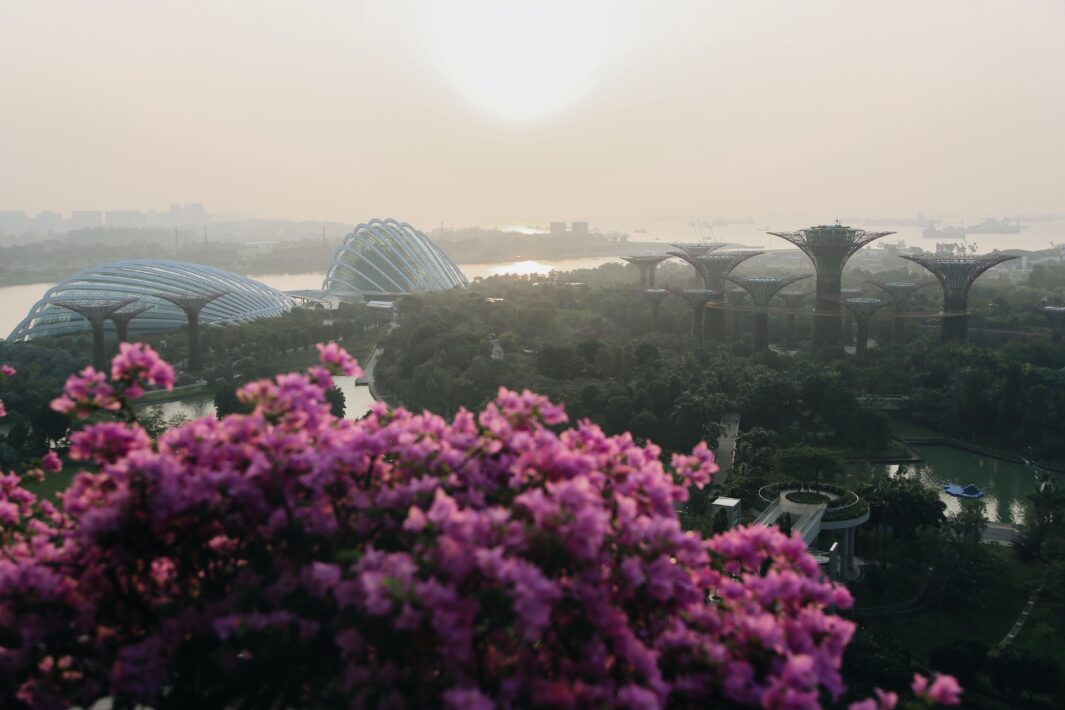

In recent weeks, Singapore has been uncomfortably reminded of how exposed a dense city can be to environmental shocks.
A familiar acrid smell has returned, but this time the haze has lingered. By 3 pm on 14 October, the hourly PM2.5 reading ranged from Elevated in the north to Very High in the west, at 140 to 288 µg/m3. Across the region, widespread hotspots were detected in Sumatra and Kalimantan, with smoke haze drifting towards Singapore and neighbouring areas. Showers may offer temporary relief, but shifting winds can quickly bring the smoke back.
An urban forest cannot stop transboundary haze. But the episode makes one thing especially tangible: clean air has value, and natural systems quietly help provide it. Trees remove pollutants at neighbourhood scale even when the larger regional problem lies beyond Singapore’s borders.
As our island grows denser, the choice between keeping a patch of forest and putting the land to another use will only get harder. Yet one question should sit at the heart of every such decision: What is a forest worth, and who does it matter to?
To illustrate what is at stake, consider a 10-hectare secondary forest that could be cleared for urban development. What public benefits would be lost if it were gone?
The forests we are quietly losing
We often picture forests as ancient, untouched jungles. But many green patches in Singapore are secondary forests, which grew back on land once cleared for farms, kampongs, or other uses. They are relatively young, but far from worthless.
A 2023 study using satellite images and historical maps found that from 2011 to 2021, Singapore lost around 1,782 hectares of secondary forest to development, and that our remaining forests are being broken into ever-smaller fragments. Roughly 80 per cent of remaining patches are now under one hectare. Yet a handful of large tracts carry most of the ecological weight.
They are not throwaway spaces. Even a modest, well-connected secondary forest tract does real work: filtering pollutants, buffering stormwater, giving people space to exercise and recover, sheltering wildlife, storing carbon, and cooling its surroundings.
Trees intercept particulate matter and absorb gaseous pollutants through their leaves. A local forest cannot stop smoke drifting in from Sumatra or Kalimantan, but at neighbourhood scale it still removes pollutants from the air. That background service is easy to overlook – until clean air itself becomes scarce.
What is cleaner air worth?
One way to estimate it is through benefit transfer. A study of US urban tree cover estimated an average pollution-removal value of US$481.47 per hectare per year in 2010.
A forest performs that service year after year. For recurring annual benefits in our model, we use a 60-year horizon and a 2.5 per cent discount rate, giving a present-value factor of about 30.9. For a 10-hectare forest, the air-quality benefit is therefore about S$0.2 million today.
And clean air is only the start
Flood buffering is another service. Forest canopies, leaf litter, and soil intercept and slow rainfall, reducing the amount of water rushing into drains at once. Using S$30 million as our severe-flood loss proxy, our model gives the 10-hectare forest a flood-buffering value of about S$2.8 million.
Then there is human health. For physical activity, we use willingness to pay for more walkable environments as a proxy: £13.65 per person per week in the original UK study. We assume one hectare of the forest is publicly accessible and serves 1,250 people, consistent with Singapore’s park-planning benchmark. On that basis, the physical-health value is about S$46.7 million.
Mental health adds another layer. A Singapore study estimated an excess cost of S$3,938.90 per person per year for mental disorders in 2016. Combining this proxy with local prevalence and evidence of improved remission from forest-based cognitive behavioural therapy yields about S$13.1 million for the same group of users.
Biodiversity is harder to put on a balance sheet, but not impossible to value. A Singapore-specific choice experiment in 2017 estimated willingness to pay at S$1.91 per household per year for each 1 per cent improvement in habitat provision and ecosystem preservation. Attributing 0.5 per cent of that service to our 10-hectare forest gives a present value of about S$54.9 million. This remains an indicative non-market value, not a market price; actual value also depends on habitat quality and connectivity.
Then there is carbon. Forests provide two related climate benefits: they remove carbon dioxide from the atmosphere and retain carbon already stored in their trees and soil. If the forest is cleared, future sequestration is reduced or lost; in our illustrative counterfactual, we also assume the existing carbon stock would be released. To avoid double-counting, we value the existing stock separately from additional carbon sequestered over time. Using Estrada et al.’s (2025) base social cost of carbon of US$187 per tonne in 2005 dollars, converted using purchasing power parity and adjusted to 2026 prices, these benefits amount to approximately S$3.6 million for our 10-hectare forest.
Climate benefits become potentially larger when urban heat island effects are considered. Estrada et al. (2025) estimate that accounting for urban heat island warming increases the global social cost of carbon by approximately US$303 per tonne in 2005 dollars. Applying this additional damage component to the same avoided carbon emissions and continued sequestration yields approximately S$5.8 million in further climate benefits. This captures the additional damages associated with urban warming, rather than the forest’s direct cooling effect on its immediate surroundings, which remains separately unquantified and unpriced.
Taken together, these quantified benefits – air quality improvement, flood buffering, human health, biodiversity conservation, and climate benefits including the additional urban heat component – yield about S$127 million for a 10-hectare secondary forest.
This is not a market price or revenue figure, but an illustrative estimate of public benefits under stated assumptions, including the avoided release of the existing carbon stock. It also leaves other ecosystem services, such as direct local cooling, unquantified.
Counting what we have been leaving out
If forests are this valuable, why do we brush them aside so easily?
Part of the answer lies in how we assess development. We meticulously count a project’s costs and return in dollars, but the value of the nature it replaces is often far less visible.
That gap is fixable. We already count felled trees, affected streams, and disturbed habitats; we can go further and value the services they provide. When stakeholders assess the benefits and costs of conservation and development against the same baseline, they can judge more clearly whether a site generates greater overall value as a standing forest or when converted to another use.
Who benefits – and who bears the costs – also matters. Those directly involved in a development are not the only stakeholders; future users, neighbouring communities, and the wider public will live with the consequences. The strong public feeling in recent debates shows those interests are real and deserve to be counted, not left as an afterthought.
A fuller accounting
None of this means we should not build homes and industrial parks. But framing the choice simply as “forest or development” tells only a fragment of the story. Reusing already-cleared land is one option; the point is to widen our choices before reaching for the chainsaw.
The tools to do this are arriving – planning frameworks that treat liveability and resilience as measurable outcomes, and methods that estimate the economic, environmental, and social return on every dollar spent.
The haze in Singapore is not something any local forest could prevent. But it makes one thing hard to ignore: clean air has value, and nature can provide part of it.
The best outcome, when the next forest comes up for debate, may not simply be how much green space is retained. It may be a better-informed, more collaborative conversation about the true value of the forests we all quietly depend on – and who that value matters to.
This article was first published in The Edge and is co-authored with Jefferson. Associate Professor Weina Zhang is with the Department of Finance at NUS Business School and Deputy Director of the Sustainable and Green Finance Institute (SGFIN) at the National University of Singapore. Jefferson is a research associate with SGFIN.